Back to Work

2025 · UX Researcher and Designer

Enhancing Off-Campus Living

A group research-focused exploration and design of a sustainable, community-driven student marketplace

Course

INFO 3450: Human Computer Interaction

Focus Areas

HCI, User Research,
UX Design, User Testing

Tools Used

FigJam, Figma, TurboScribe

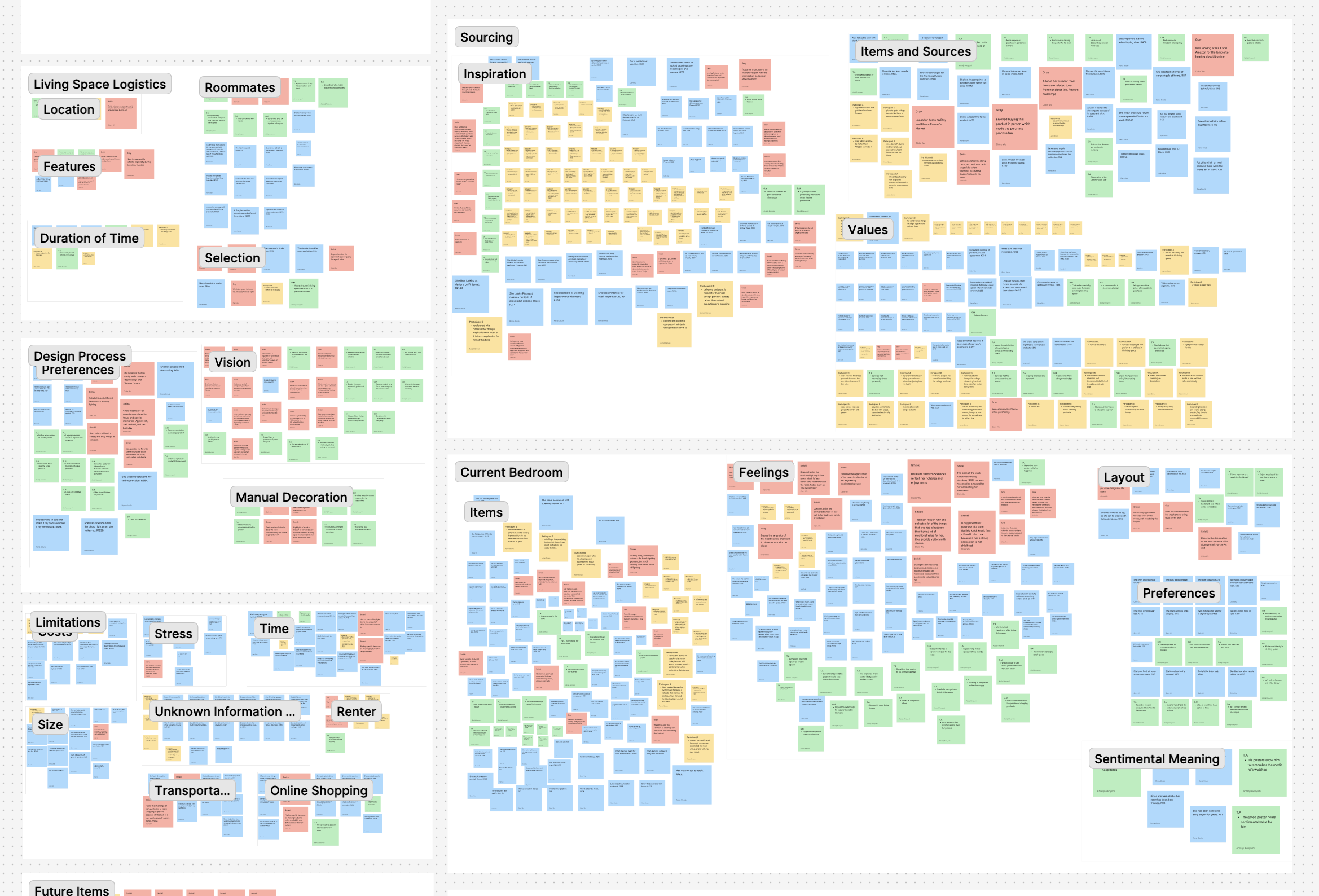
Research Synthesis

Research Insights

Proximity & Limited Mobility

Most off-campus students do not own cars, making walkability and public transit ease primary constraints in purchasing decisions. Proximity reduces logistical friction and increases trust, as students feel more comfortable transacting within a short walking radius.

Time Scarcity

Decorating competes with coursework, jobs, and extracurricular commitments. Students perceive coordination, authentication, and logistics as time costs rather than monetary costs, prioritizing speed and ease over marginal savings.

Finite Budgets

Tight financial constraints require students to weigh affordability against quality and longevity. Many approach purchases cautiously, balancing immediate needs with resale value and durability.

Emotional & Functional Spaces

Students evaluate their living spaces based on both practicality and emotional resonance. Decor is not purely aesthetic. It creates stablity, identity and comfort within a high pressure academic environment. Sentimental items often outweigh purely decorative ones.

Temporary Ownership Psychology

Off-campus living fosters a short-term ownership mindset for most students. Students anticipate reselling or parting with items at the end of a lease cycle, making condition preservation and resale potential central to decision-making.

Problem Statement

Cornell undergraduate students living off-campus without cars need to localize their decorating process to be more accessible, sustainable, and community-driven, given existing competing academic, personal, and financial demands.

The Concept: Homie

A localized and community-driven decor marketplace combining digital coordination with physical pickup stations to reduce cost, friction, and transport barriers.

Key Features

1. The Marketplace
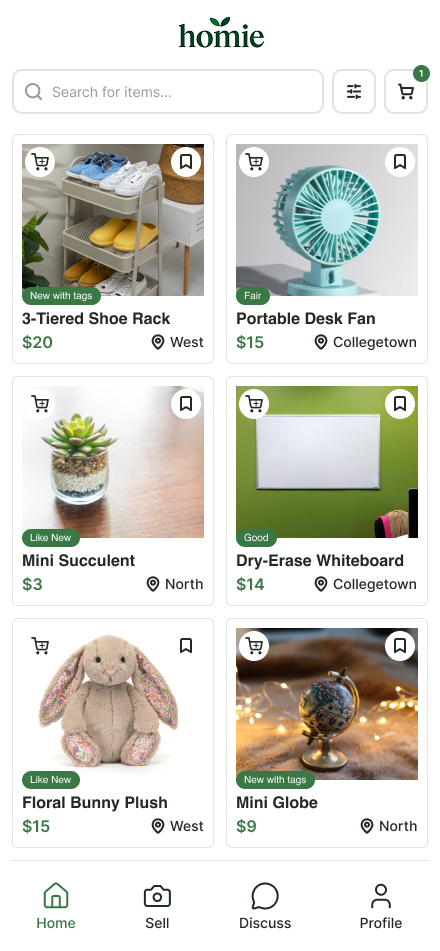
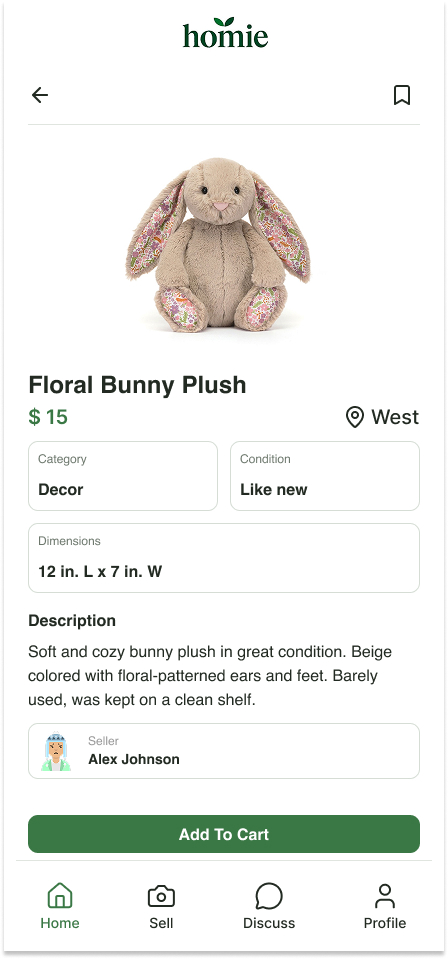
A proximity-based peer-to-peer marketplace for buying and selling decorative goods within a walkable radius.
  • Geofencing: Browse and list items only within the Cornell campus; regions defined within the app
  • Peer Reviews: Seller reputation based on community feedback and transactions
  • Smart Listings: Searchable feed with inline search + filtering capabilities
2. HomieBoard
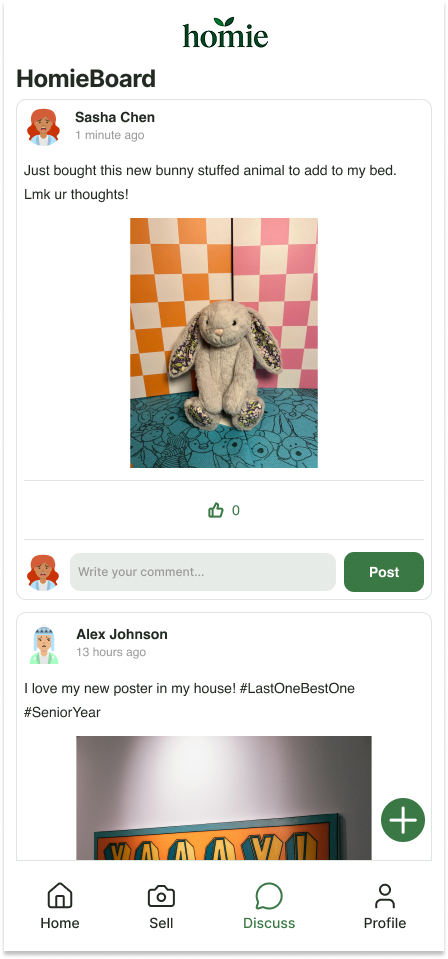
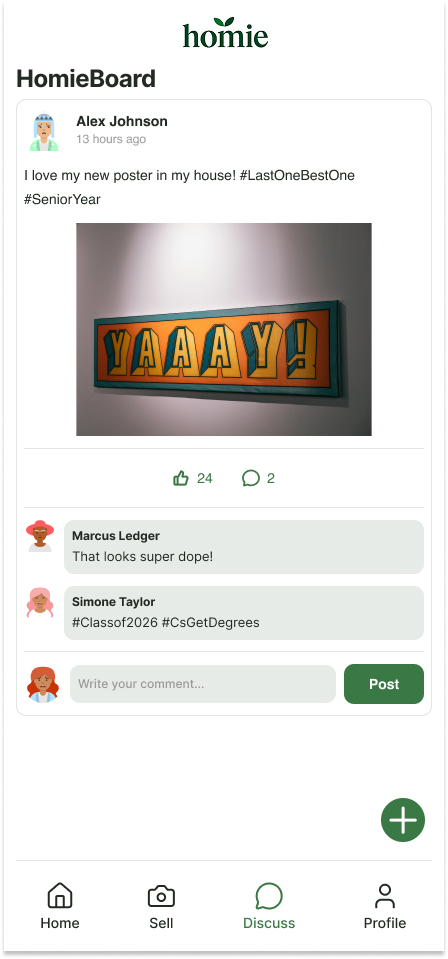
A community discussion space for users to post and communicate with users about their decorative items.
  • User Engagement: Like and comment functionality to foster interactions and community feedback
  • Collaborative Support: Users can help each other with advice, tips, or recommendations
  • Real-Time Updates: See the latest posts and interactions as they happen
3. Campus Pick-up Stations
Physical fulfillment hubs in convenient campus areas where students can drop off or pick up items.
  • Accessible Locations: Strategically placed to be within easy reach for students
  • Flexible Use: Drop off or pick up items at your convenience
  • Seamless Integration: Works with the app to track items and notify users

Design Exploration

We translated our research insights into iterative designs, moving from low-fidelity sketches and storyboards to higher-fidelity interactive prototypes. Our early explorations helped us test information hierarchy and visualize real user scenarios before committing to interface details.

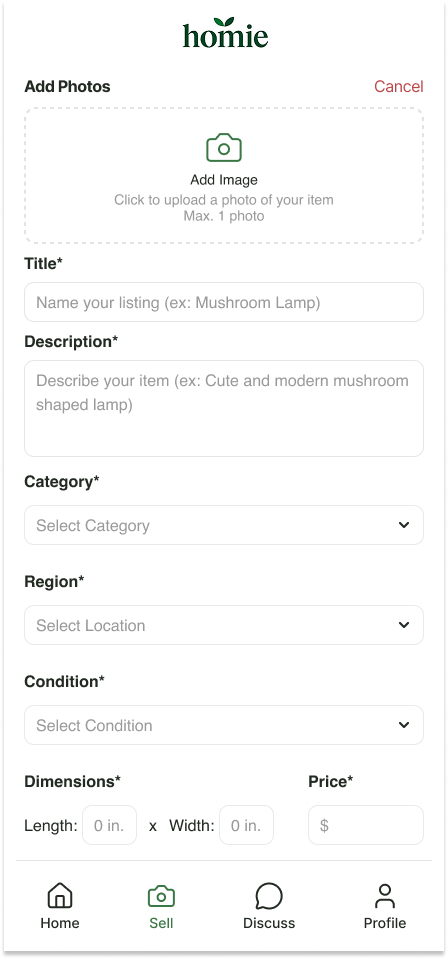
I led the transition from low- to high-fidelity, designing our application end-to-end in Figma. I built the resuable UI components and defined the structure, layout, and interaction patterns across the marketplace, listing flows, and profiles.

Usability Refinement

Evaluation Methods

We first tested early interaction flows through paper prototyping to validate core navigation and app logic before investing in higher-fidelity refinement. The team observed user behavior for moments of friction, comparing it against defined happy paths to identify breakdowns in clarity and unmet expectations.

After developing the prototype, we conducted moderated usability tests using a think-aloud protocol. Participants completed five key user tasks reflecting realistic use cases:

Browse and purchase a listing

Post an item as a listing

Create a post on the HomieBoard

Start the drop-off process for a sold item

Locate the pickup station for a purchased item

Findings and Adjustments

Profiles Were Not
Easily Discoverable

PROBLEM

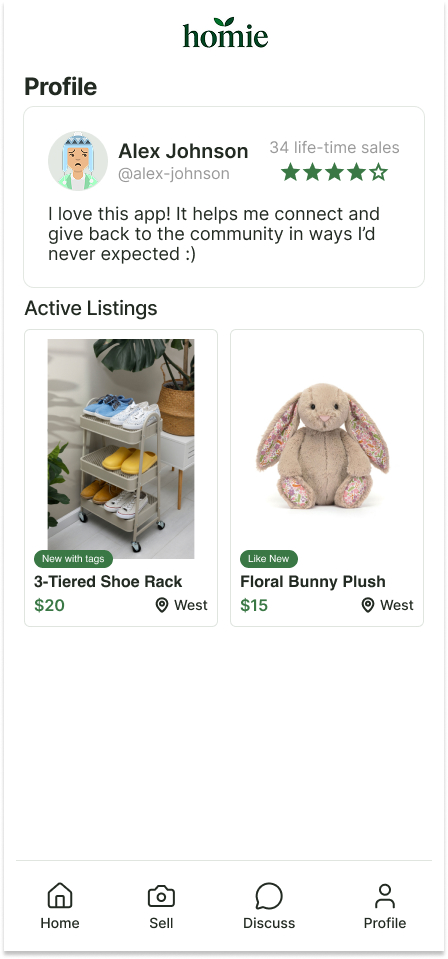
Users expected names and profile photos to be clickable on universally. The inability to view profiles violated platform conventions.

SOLUTION

Enabled profile photo clickability across the application allowing users to view full profiles

OUTCOME

Increased transparency and credibility to strengthen
peer-to-peer relationships
Cart Logic Didn't Match
Real-World Use

PROBLEM

The cart design did not support multiple items with different pickup locations. Users expected flexibility similar to other similar platforms

SOLUTION

Redesigned the cart to support individualized pickup location selection

OUTCOME

Re-aligned functionality with common design expectations
HomieBoard Lacked Interaction

PROBLEM

Users could "like" posts but not comment. This limited engagement and contradicted the community space's purpose.

SOLUTION

Introduced a comment function alongside the like button to support conversation and feedback

OUTCOME

Transformed HomieBoard into an improved community hub

Reflection

Lessons Learned

1

Physical Infrastructure Matters

Some problems can't be solveld purely through digital tools; integrating physical infrastructure like pickup stations was essential for enabling coordination amongst the user group

2

Trust is Built Through Small Successful Interactions

Small features like clickable profiles, visible seller info, and comments collectively built credibility and aligned with user expecations

3

Designing for Reality = Designing for Edge Cases

Edge cases revelaed that users' purchasing and pickup behaviors are more varied than anticipated, required flexible workflows and that handle diverse real-world scenarios

4

Community Cannot Be Implied, It Must Be Designed

Community building doesn't happen automatically; explicit features like profiles and commenting are necessary to foster dialogue and shared activity